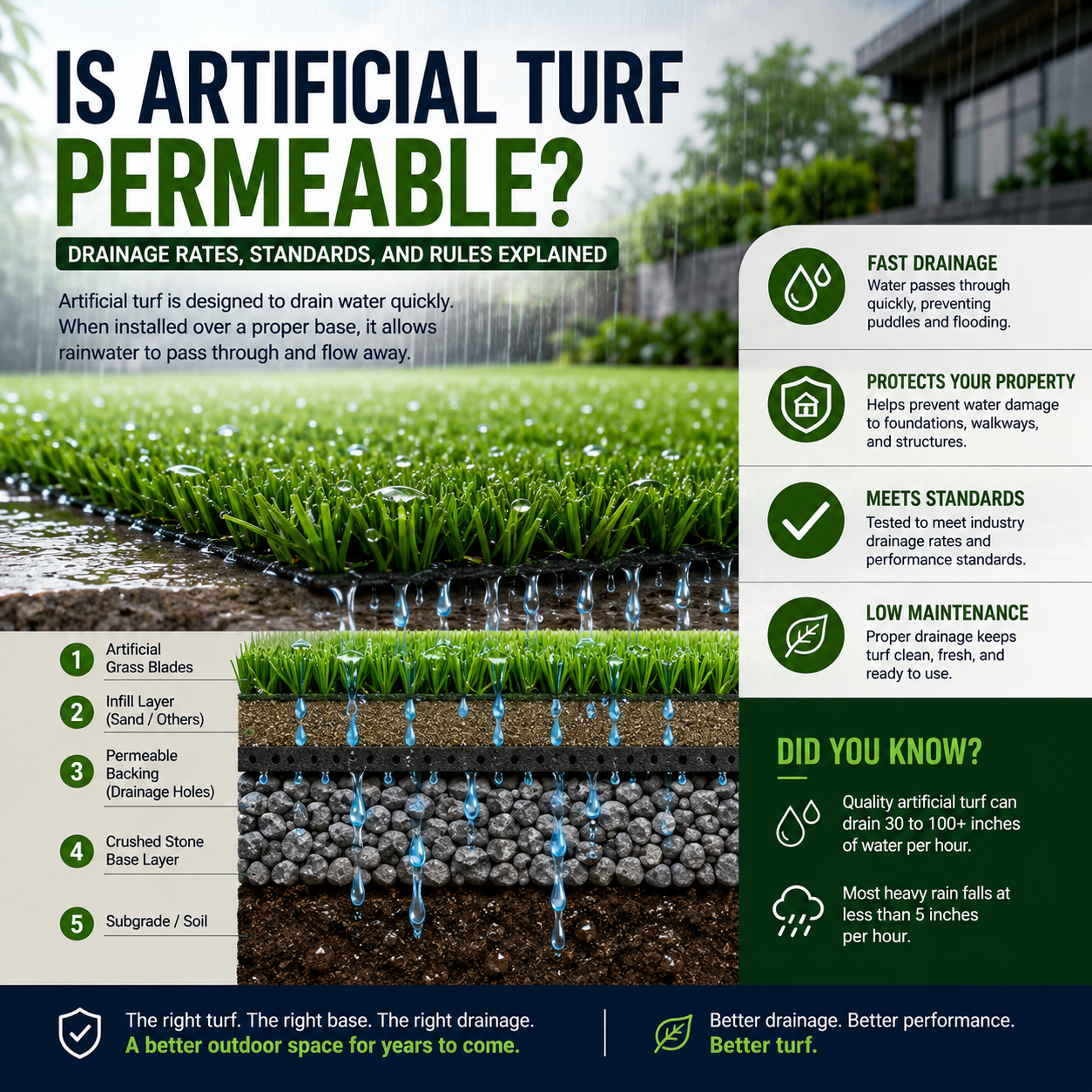
If you are planning to install synthetic grass, one big question usually comes up: is artificial turf permeable? Many homeowners worry about drainage, standing water, pet urine, and whether artificial grass can handle heavy rain.
Quick Answer: Is Artificial Turf Permeable?
Yes, most modern artificial turf is permeable at the material level. Water can pass through the turf backing and drainage holes quickly. However, whether the full installation drains well depends on the base, soil conditions, slope, drainage design, and local stormwater rules.
In simple terms, the turf surface may drain fast, but the whole system still needs to be installed correctly.
Why Permeability Matters for Artificial Turf
Permeability means how easily water can move through a surface. For artificial grass, this matters because poor drainage can cause puddles, odors, soft spots, and runoff around nearby patios, walkways, or foundations.
Good drainage helps:
- Move rainwater away from the surface
- Keep yards, patios, and pet areas usable after storms
- Reduce standing water and odor buildup
- Protect nearby hardscapes and foundations
- Meet local building or stormwater requirements
Whether you are installing artificial grass in a backyard, dog run, balcony, playground, or commercial area, drainage should be part of the plan from the beginning.
What Does “Permeable” Mean in Landscaping?
In landscaping and construction, surfaces are often described as either permeable or impervious.
Permeable surfaces allow water to pass through and soak into the ground. Natural grass, gravel, and some permeable pavers are common examples.
Impervious surfaces block water from soaking directly into the soil. Concrete, asphalt, rooftops, and many compacted hard surfaces are usually considered impervious.
Artificial turf falls somewhere in between. The turf material itself can allow water to pass through, but the ground or surface below may not absorb water the same way natural soil does. That is why artificial grass should be viewed as a full drainage system, not just a green surface.

Is Artificial Turf Permeable at the Material Level?
In most cases, yes. Modern artificial turf is designed so water can move through the surface and backing.
A typical artificial grass product includes:
- Synthetic grass blades
- A backing layer
- Drainage holes or permeable backing
- Infill between the blades
Rainwater moves between the grass blades, passes through the infill, and exits through the backing. Some turf products use punched drainage holes, while higher-drainage options may use a more permeable backing that allows water to move through more evenly.
Lower-cost turf may have fewer drainage holes or a less efficient backing. For areas with heavy rain, pets, or frequent cleaning, choosing turf with strong drainage performance is especially important.
How Artificial Turf Drainage Systems Work
Artificial turf drainage depends on more than the turf roll. The layers below the grass are often more important than the surface itself.
Turf and Infill Layer
Rain first passes through the grass blades and into the infill. Infill helps support the blades, adds weight, and allows water to move downward. The right infill can help water flow evenly across the surface.
For pet areas, infill choice matters even more because both rainwater and pet urine need to move through the turf quickly.
Base Layers and Subgrade
Below the turf, most landscape installations use a crushed stone or aggregate base. This base helps:
- Store water temporarily
- Spread water below the turf
- Move water toward drains, edges, or lower ground
- Create a stable surface for the turf
The soil below the base may absorb some water, or the system may need to move water toward drainage pipes or outlets.
Why the Base Matters Most
Even if the turf drains quickly, a poorly prepared base can still cause pooling. Many drainage problems blamed on artificial grass are actually caused by compacted soil, low spots, poor slope, or blocked drainage paths.
A well-built base is what helps the turf system perform during heavy rain.
Artificial Turf Drainage Rates Explained
A common question is whether artificial turf is permeable enough for heavy rain. Drainage rate helps answer this.
Drainage rate is usually measured in inches per hour. Many quality artificial turf products can drain between 30 and more than 100 inches of water per hour, depending on the backing and system design.
For comparison, most heavy rainstorms produce far less than 5 inches of rain per hour, and even strong thunderstorms rarely reach 10 inches per hour.
This means the turf material itself often drains faster than rain falls. When water problems happen, they are usually caused by the base, soil, slope, concrete surface, or drainage design underneath the turf.

Industry Standards and Drainage Testing
Drainage performance is not just a marketing claim. For professional projects, turf systems and base materials may be evaluated using recognized test methods.
ASTM F1551
ASTM F1551 is commonly referenced for evaluating synthetic turf playing surfaces and materials. It may be used as part of a broader testing process to understand how turf systems perform.
ASTM F2898
For sports fields and commercial turf systems, drainage may also be evaluated using ASTM F2898. This test focuses on the permeability of synthetic turf sports field base stone and surface systems.
ASTM D2434
ASTM D2434 may be used to evaluate how water flows through granular soil or aggregate materials below the turf. This is useful because the base layer often controls how well the full system drains.
For homeowners, you do not usually need to run lab tests. But these standards show why turf drainage should be treated as a complete system, especially for large projects, commercial spaces, and sports surfaces.
Is Artificial Turf Considered Permeable Under Local Rules?
This is where confusion often starts. Artificial turf may drain water through the surface, but local building and stormwater rules may still treat it as impervious.
Many local stormwater programs classify artificial turf as impervious unless the system is professionally designed and documented as a stormwater control feature. This is because artificial grass can reduce direct contact between rain and natural soil, and it may still produce runoff during heavy storms.
Local rules vary by city, county, and state. Always check local building or stormwater requirements before installation, especially if your project affects lot coverage, drainage permits, or stormwater fees.
A good rule of thumb is this: turf may be physically permeable, but it is not always legally counted as permeable.
Can Artificial Turf Be Permeable Over Concrete?
Yes, artificial turf can drain over concrete, but concrete itself does not absorb water. In this type of installation, water must move across the concrete surface toward an existing drain, edge, or outlet.
This is common for:
- Patios
- Balconies
- Rooftops
- Dog runs
- Poolside areas
- Outdoor play spaces
A slight slope is important. If the concrete is flat or has low spots, water may collect under the turf. For patios, balconies, rooftops, and pet areas, a drainage mat can help create space under the turf so water can move away more easily.
If you are installing turf over concrete for dogs, drainage is especially important because pet urine needs a clear path out of the turf system.
Drainage Design Tips for Home Lawns, Pet Areas, and Sports Fields
Different spaces need different drainage setups.
For home lawns, a crushed stone base of about 3 to 6 inches is commonly used, depending on soil conditions and project needs. The ground should have a slight slope that moves water away from the house and nearby structures.
For clay soil, extra drainage may be needed because clay absorbs water slowly. French drains, gravel trenches, or drain pipes can help prevent water from sitting below the turf.
For pet turf, choose artificial grass with drainage holes or a highly permeable backing. A deeper base, proper slope, and regular rinsing can help reduce odors and keep the area cleaner.
For sports fields and commercial spaces, drainage should be designed more carefully. These projects may require deeper stone bases, engineered slopes, underground drain pipes, and regular maintenance.
If you are choosing artificial grass for a backyard, patio, balcony, or pet area, look for turf with strong drainage and the right pile height for your use case. LITA Artificial Grass offers turf options for different outdoor spaces, and custom-size ordering can help reduce cutting waste during installation.
For dog runs and pet spaces, you can also explore lita pet turf and drainage-friendly accessories for a cleaner, easier-to-maintain setup.

Common Myths About Artificial Turf Drainage
Myth 1: Artificial turf always causes flooding
Artificial turf itself does not automatically cause flooding. Problems usually happen when the base is poorly prepared, the soil is compacted, or water has no clear exit path.
With the right base and slope, artificial grass can drain very effectively.
Myth 2: A high drainage rate means turf is always legally permeable
Drainage speed and legal permeability are not the same thing. A turf product may drain water quickly, but local rules may still classify it as impervious unless the full system is designed for stormwater control.
Myth 3: Infill does not matter
Infill can affect how water moves through the surface. The right infill helps support the turf fibers and allows water to flow more evenly. Poor or incorrect infill can contribute to wet spots, odor, or uneven performance.
Myth 4: Turf over concrete does not need drainage planning
Concrete does not absorb water. If artificial turf is installed over concrete, the water still needs a slope, drain, edge, or outlet. Without that drainage path, water can sit under the turf.
FAQs About Artificial Turf Permeability
Is artificial turf permeable to water?
Yes. Most modern artificial turf allows water to pass through the backing or drainage holes, but the full system also depends on the base, slope, and surface below.
Does artificial grass drain better than natural grass?
Artificial grass can drain very quickly at the surface, but natural grass absorbs some water into the soil. The better option depends on the soil, base, slope, and drainage design.
Why is water pooling on my artificial turf?
Pooling usually happens because of poor base preparation, compacted soil, low spots, blocked drainage, or lack of slope.
Is artificial turf considered impervious?
In many cities, artificial turf may still be treated as impervious for stormwater rules unless it is part of an engineered drainage system. Local rules vary, so always check your area’s requirements.
Can artificial turf be installed over concrete?
Yes. Artificial turf can be installed over concrete, but the concrete needs a slope or drainage path. Since concrete does not absorb water, water must be directed to a drain, edge, or outlet.
Is artificial turf good for pet urine drainage?
Yes, if the turf has good drainage and is installed over a proper base or drainage layer. Pet areas should also be rinsed regularly to reduce odor.
Final Answer: Is Artificial Turf Permeable?
So, is artificial turf permeable? The honest answer is yes, but with an important condition.
Most modern artificial turf is designed to let water pass through the surface quickly. In many cases, the turf material drains faster than normal rainfall. However, real-world drainage depends on the full installation, including the backing, infill, base, slope, soil, concrete surface, and local drainage rules.
For the best results, choose a drainage-friendly turf product, prepare the base correctly, and make sure water has a clear place to go.
If you are planning a backyard, patio, balcony, dog run, or commercial turf project, LITA Grass offers artificial grass options for different spaces, including pet-friendly turf and custom-size choices that make installation easier.


Leave a comment
This site is protected by hCaptcha and the hCaptcha Privacy Policy and Terms of Service apply.