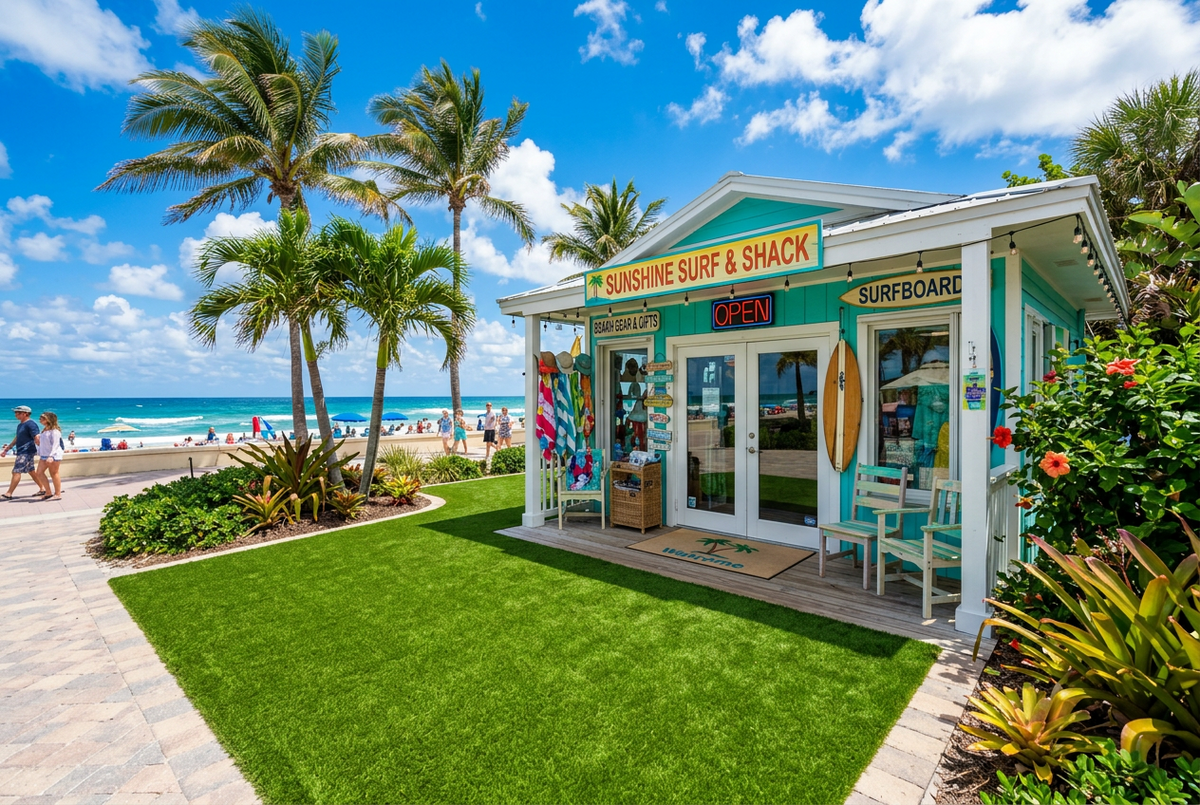
Sand comes in on flip-flops, wet boards drip at the rental counter, and a rain shower can send water straight off the awning onto the display outside. If you’re choosing artificial grass for a Florida beach shop, start with one area you want to improve. A small turf section under a towel display or beside a bench is easier to plan, clean, and test than a full storefront.
For most surf shops, souvenir stores, and beach rental counters, the layout is simple. Keep the main route to the door on a clear, firm surface, use a secured commercial entry mat where customers track in sand, and put turf in a separate display or seating area with room for water to drain.
Walk the site once as a customer and once as the person who closes the shop. Notice where customers pause to read a sign, step aside to let a cart pass, or set a bag down. Then look at those spots with a broom and a dustpan in mind. The right patch of outdoor turf gives the storefront a defined display or seating area and leaves staff room to clean it. A partly covered deck, a shopfront that gets afternoon sun, and a rental return beside a drain each need a different surface plan.
Where artificial grass works at a beachside business
Surf shops and souvenir stores
Give a beach-towel rack, a sandal display, or a photo spot its own patch of low-pile turf under a covered storefront. Leave room around the fixtures so staff can move them and brush out the sand that collects underneath. Set the display back from the door swing and the path customers use to enter.
In a discussion about sand at beach rentals, a commenter in Canada described using a sisal mat outside and two washable mats inside to catch debris. Other commenters suggested an outdoor foot rinse. At a surf shop, start at the spot where people step off the sand. Put a secured commercial scraper mat in their path and leave the display turf off to the side, where staff can clean it after closing. See the r/airbnb_hosts discussion on keeping sand outside.
Picture a towel rack on one side of a door, a pair of display boards against the wall, and a paved route straight into the shop. The turf only needs to cover the footprint of that display and the small area in front of it. Leave enough room for the rack to roll onto the pavement at closing. A turf edge tucked under a fixture can be awkward to brush, so make sure staff can reach the whole perimeter with the rack in its usual position or move the rack easily.
LITA’s 0.4-inch Artificial Grass is a sample worth starting with for this layout. The product page lists a 10-millimeter pile, identifies stores and displays as uses, and gives separate instructions for sweeping indoors and rinsing outdoors. The short profile makes it easier to see how the turf will meet the slab under a movable rack, and shallow fibers give the broom a shorter path to the grit. If a display needs more visible texture, put the 0.8-inch sample next to it and look at both from the sidewalk before picking one. Compare LITA’s 0.4-inch Artificial Grass and 0.8-inch Artificial Grass.

Beach gear rental counters
A surfer described changing in a sandy parking area and finding that sand worked its way into both a towel and a yoga mat. One reply described using a plastic shoe tray and a bucket. At a rental counter, walk through a return with an armful of wet gear. Give customers an obvious place to set a board down and keep that area on a surface that’s easy to rinse and already drains. Put a bench or bag-sorting area beside it. Keep hard paving along the route where staff roll carts loaded with boards, chairs, and umbrellas. See the r/surfing discussion about sandy changing mats.
For a Florida example of how a rental business directs customers to rinse facilities, Beach Shack Beach Rentals in Cocoa Beach points visitors to the showers and foot-rinse station in the nearby parking garage. Check what’s already available along the route from the beach to your counter, then make any rinse point easy to find. See the Beach Shack Beach Rentals FAQ.
During the busiest return window, the rack may fill before someone has time to move the boards. Set a visible return marker beside the rack so the queue stops clear of the register. Position a drip rack where the slab already falls toward the drain, and leave a strip of paving wide enough for staff to bring beach chairs back out on a cart. A turf panel can sit next to a bench for customers collecting their things. Place its edge where it stays clear of runoff from the drip rack and where staff can sweep sand toward a dustpan.
For a spot that regularly gets splash, such as a staff station beside a working rinse drain, LITA’s Gray PVC Drainage Mat has an open S-shaped mesh. The openings give water a direct path through the 5-millimeter mat. The roll is available in widths from 1 to 4 feet and can be cut to fit a narrow area beside the rack. The surface below still needs a clear outlet, and the mat needs to sit flat and secure in its intended location. Keep the drain accessible so staff can clear it while the rack is full. See LITA’s Gray PVC Drainage Mat.

Coastal cafés and resort shops
Try a turf border beside planters, a shaded photo spot, or a small seating area outside the gift shop. If chairs sit on the turf, try a sample under the actual chair legs and see how easily staff can reach the area to clean. Keep serving paths and spill-prone areas on a surface your team can wipe down quickly.
ABBQ Meat + Drink in Atlantic Beach, Florida, is a larger example. Its contractor, Avant Construction Group, documented a turf backyard patio as part of a project with 4,000 square feet of outdoor seating. The restaurant describes the backyard as a space for cornhole, kids’ play, and events. For a smaller shop, the same layout idea can fit a single bench or photo spot with room for people to pass. See Avant’s ABBQ project profile and ABBQ’s description of the backyard.
For a café with a paved serving aisle and two chairs by a planter, start by drawing the chairs in their pulled-out position. That footprint is larger than the space they occupy between customers. Put the planned turf edge outside that movement, or keep the chairs on paving and put the turf behind them as a visual border. Make sure the staff member carrying a tray still has a straightforward route from the door to the tables. If the site is a resort gift shop, use the same approach for a bench or photo area that shares space with luggage carts.
For a lawn-like accent beside a bench or planter, the 1.5-inch PU Backing Grass gives the display a fuller profile than either short-pile retail option. Its listing specifies a polyurethane backing and allows outdoor rinsing. Try that longer pile in a quieter corner where the look matters and staff can brush around the furniture. Use the sample on the actual ground to check chair feet and the edge transition. Take a look at LITA’s 1.5-inch PU Backing Grass.

How to choose commercial turf for a coastal storefront
Choose a pile you can brush clean
Start with a dense, short-pile sample for an outdoor retail display. Shorter fibers generally make grit easier to reach with a brush. Shake a little dry sand onto the sample, brush it out, and see how much stays near the backing. If customers regularly stand on the area, check the manufacturer’s guidance for expected foot traffic and routine cleaning. Compare profiles in LITA’s low-pile artificial grass guide.
Run the test with the same amount of sand, the same brush, and several strokes on each sample. Brush one half parallel to the fibers and one half across them to find a direction that works for your crew. Look at the underside after you lift each sample, since grit can also collect at the perimeter. If a clothing rack or a sign stand will move every night, set one foot or caster on the sample. Check how far it sinks and what happens as it passes over the edge. Include the proposed backing and trim when you assess the transition.
Follow the water across the concrete
A homeowner in Viera, Florida, reported that water sat on a concrete lanai under artificial grass covers and that mold appeared. Their experience illustrates what to look for before covering a shop patio. A permeable backing lets water through the turf. The concrete underneath still needs a slope and a clear way for that water to leave. See the Viera homeowner’s patio post on r/landscaping.
Walk your storefront when the rain stops. Where does water come off the awning? Does it cross the door? Follow it to the drain or open edge, and check for puddles under the planned display. If the same area holds water after each shower, fix the drainage before you cover the slab. See LITA’s guide to artificial turf drainage.
For a rain-exposed display, ask to see the underside of the exact turf you plan to buy. A backing with drainage openings lets water pass through the grass. On a concrete patio, that water has to travel across the slab to an open edge or drain. Plan the fixing method, seams, and edging around that route. Keep drain grates reachable. If you set the display directly under a roof drip line, take a look during a shower to see how much water actually comes off the roof and where it lands.
On a soil-based courtyard, the work below the turf is different. Ask the installer how the prepared base will support the turf and where water will go during a heavy rain. Mark the paved walkway, planters, downspouts, and any low corner on the same sketch. An edge against existing pavement needs to stay firm as people step across it. Have the installer check how that transition and the finished drainage will work together before ordering a roll.

Check door clearance, edges, and afternoon sun
Measure clearance with the door fully open and account for the thickness of the entire installation. Follow the manufacturer’s instructions for fastening edges and seams to the existing surface, especially where wind reaches the storefront. If the project touches a required accessible route, check the applicable surface and transition requirements with your installer. See the U.S. Access Board’s guide to floor and ground surfaces.
In a Fort Lauderdale discussion about synthetic grass, one homeowner described good results in a shaded backyard, and several commenters raised concerns about heat in direct sun. For a storefront, put the same outdoor-rated sample out in the shade and in the afternoon sun. Compare both during the hours when customers are likely to stand there barefoot. See the Fort Lauderdale Reddit discussion and LITA’s artificial grass FAQ.
LITA describes its turf as UV-protected and tested. For merchandise displays, UV protection matters because the fibers repeatedly see daylight, even on a partly covered storefront. A western exposure may put the entire display in direct sun by the time the afternoon rental crowd arrives. UV protection addresses the fibers’ exposure to sunlight. For barefoot comfort, check surface warmth separately and put the longest waits under shade. If you have the same display at several branches, compare each location’s exposure before using a single layout everywhere. For a major fit-out, ask for the UV and color-retention information for the specific product under consideration.
Make a full pass with the store open. Open the door the whole way, push a loaded cart along the normal route, and see where customers queue when someone stops at the display. On a leased storefront, show the property manager where the proposed edges, seams, anchors, or adhesive will go. The same drawing helps the installer place transitions and keep access to drains and fixtures that employees service. On an exposed corner, confirm how the manufacturer calls for the perimeter to be secured so it stays flat during routine use and windy weather.
How to clean sand out of artificial turf
On busy beach days, shake out or clean the entry mat according to its care instructions, then brush the turf when the sand is dry. Start under the towel racks, along the seam beside the paved path, and around the feet of benches. Use a stiff nylon broom to lift loose sand toward an edge where you can sweep it into a dustpan. If fine grit remains, rinse lightly when the care instructions allow and the area has a clear drainage path. After a heavy shower, check the drain and look for any seam or edge that has lifted. See LITA’s artificial grass cleaning guide.
At opening, look first at yesterday’s high-traffic spots. Sand often lands where a customer stops, turns, or lays down a beach bag. The corner nearest the boardwalk and the floor beneath a changing bench may need attention first. During the day, empty the scraper mat when it stops holding grit effectively and remove larger debris such as tags or leaves by hand. Keep a broom and a dustpan by the supply door so staff can clean the display without crossing the shop with a wet mop.
At closing, move any display fixtures that are meant to roll away and sweep the grit out of the exposed corners. If the rental station uses an open-grid drainage mat, follow its care directions and clear collected sand from the floor underneath and around the drain. Where an approved installation lets staff lift a mat for cleaning, put it back flat and in its original position. After several busy days, note which part takes the most time to clean. That pattern can tell you where to move a bench, shorten a turf edge, or change the position of the scraper mat.
Measure one area before you order
A 6-by-10-foot display uses 60 square feet before trimming. Measure the actual width and length, sketch the door swing and nearby drains, and compare available roll widths. A single cut can simplify a small display. If you need multiple pieces, plan the seams and keep the grass blades facing the same direction.
If the wall is slightly out of square, measure the width at both ends and at the middle. Write the three numbers on the sketch along with the direction shoppers see the turf from the street. Show whether the cut runs against a wall, a curb, or open paving. Ask for the available roll widths and any trimming allowance before pricing the order, especially around posts or corners. Check the proposed seam position against the wheels of the fixtures you move most often. If the edges of the space need trim or a transition, measure those runs separately from the turf footprint.
When you compare two quotes, check what each one covers. Turf square footage, cut sizes, edging, and installation labor may appear as separate line items. Ask whether the quoted layout includes a seam and which surface preparation is included. If a downspout or a low spot needs work, identify who will handle it before the turf is cut. Check that both quotes use the same finished dimensions and placement. A smaller shop may want one display cut and a separate mat roll for the rental station. Keeping those measurements separate makes it easier to see what you need for opening day and what can wait until the first installation has been tested.
Walk through a mock layout before making a permanent installation. Place the rack and sign where they will normally sit, mark the boundaries, and check whether two people can pass along the main paved route. Try the sample with a broom and the feet of the furniture that will sit on it. Photograph the area in sun and shade. On the next rainy day, take a second picture that shows runoff and the nearest drain. Those photos and the sketch give the supplier enough context to discuss height, backing, cuts, seams, and installation accessories.

Check the first installation before repeating it
After the first area is installed, watch what happens on a busy afternoon and after a shower. Make a quick record of where sand gathers, whether the seam beside the rack stays flat, and how long staff spend on their closing sweep. Check that water exits where you expected and that the ground around the drain is still reachable. Ask the people who move the fixtures whether the new position makes their work easier. If you are trying the layout across several shops, keep a photo and a copy of the material specifications with each location’s sketch.
Order for the next location using its own measurements and delivery ZIP code. One shop might repeat the short-pile display and place it a few inches farther from the entrance. Another might have a deeper awning and enough room for the fuller turf beside a bench. Make a separate note for any gray PVC mat needed near a rinse station. This gives you a list with clear quantities for each material and helps tie every product to a job your staff actually needs it to do.
Bring those measurements and a photo of the surface when you request an artificial grass sample from LITA. Compare the color outside your shop, test how easily it brushes clean, and check how the finished edge will meet the pavement. To compare products, browse LITA’s commercial collection. If you’re planning several storefronts, share your total square footage and delivery ZIP codes with the LITA wholesale team.


Leave a comment
This site is protected by hCaptcha and the hCaptcha Privacy Policy and Terms of Service apply.